
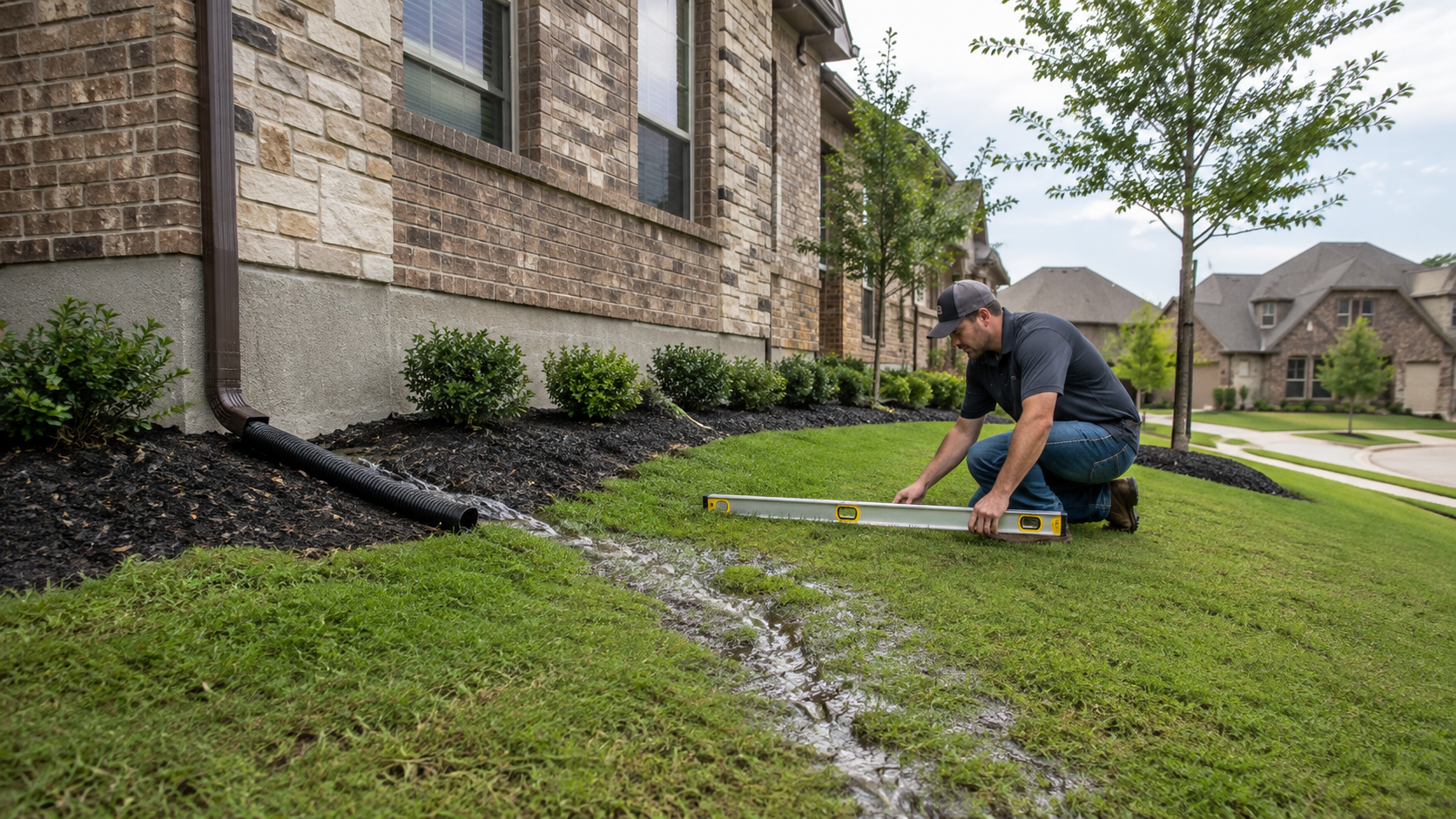

In North Texas, protecting your foundation often starts with something surprisingly simple: the slope of the soil around your home.
Yard grading determines where rainwater travels after it hits the ground. When your property is graded correctly, water flows away from the foundation. When the yard slopes toward the house instead, water can collect along the foundation and contribute to soil movement, drainage problems, and potentially costly structural damage.
Because homes throughout the Dallas–Fort Worth area are built on expansive clay soils, proper grading is especially important. Understanding how your yard directs water can help you identify problems early and reduce unnecessary stress on your foundation.
What Does “Positive Grade” Mean?
A positive grade means the ground slopes downward as it moves away from your home.
This allows rainwater to naturally drain away from the foundation instead of pooling beside it.
A negative grade is the opposite: the ground slopes toward the home. Water then follows gravity toward the foundation, where it may collect after storms or irrigation.
Even relatively small grading problems can become important over time, particularly during the dramatic wet-and-dry cycles common in North Texas.
Ideally, the soil immediately surrounding your home should have a noticeable but gradual slope away from the structure. The goal is not to create a steep hill, but to make sure water has a clear path away from the foundation.
How to Check the Slope Around Your Home
You do not necessarily need specialized equipment to identify obvious grading problems.
Start by walking around the perimeter of your home and looking closely at how the soil sits in relation to the foundation.
Pay particular attention to areas where:
- Soil appears to slope toward the house.
- Water remains next to the foundation after rainfall.
- Mulch beds create a depression against the home.
- Soil has settled near patios, sidewalks, or driveways.
- Downspouts discharge water directly beside the foundation.
- Erosion has created channels or low areas along the house.
- Grass remains unusually wet near certain sections of the foundation.
One of the easiest tests is simply observing your property during or shortly after a heavy rain. Water should move away from the house rather than collecting beside it.
For a more precise check, a long level, straight board, string line, or laser level can be used to measure changes in elevation.
As a general rule, the area closest to the foundation should slope gradually away from the house for several feet whenever the property layout allows.
Why Negative Grading Is Especially Problematic on DFW Clay Soil
The expansive clay soils found throughout Dallas, Fort Worth, and surrounding North Texas communities react strongly to changes in moisture.
When clay soil absorbs water, it expands. When it dries, it contracts.
This repeated movement creates one of the biggest challenges for foundations in the DFW region.
Negative grading can intensify the problem by concentrating water along one portion of the foundation. After heavy rainfall, saturated clay soil may swell significantly. During drought conditions, that same soil may shrink and pull away from the foundation.
Uneven moisture levels are particularly concerning.
For example, one side of a house may remain saturated because of poor grading while another side dries quickly. These differences can contribute to uneven soil movement underneath the structure.
Over time, homeowners may begin noticing symptoms such as:
- Cracks in interior walls or ceilings.
- Cracks in brick or exterior masonry.
- Doors or windows that begin sticking.
- Gaps between walls and ceilings.
- Uneven or sloping floors.
- Separation around exterior trim.
- Cracks in concrete slabs or patios.
Not every crack means a home has a serious foundation problem, but drainage and grading issues are important factors to investigate when these symptoms appear.
DIY Yard Grading Basics
Some minor grading corrections can be handled by homeowners.
If a small area has settled next to the foundation, adding and compacting appropriate soil may help restore a positive slope.
The process generally involves removing landscaping materials, filling low areas with suitable soil, compacting the soil, and shaping the surface so that water moves away from the house.
However, there are several important precautions.
Avoid piling soil too high against brick, siding, weep holes, or other exterior components. Covering areas that are designed for ventilation or drainage can create additional moisture problems.
Homeowners should also be careful not to simply move water from one problem area to another. Redirecting runoff toward a neighbor’s property, driveway, patio, or another low point may create new drainage issues.
Grading should be considered part of an overall water-management strategy rather than an isolated fix.
When Should You Call a Professional?
Minor low spots may be manageable as a DIY project, but larger drainage problems usually require professional evaluation.
Consider calling a professional if:
- Large portions of the property slope toward the home.
- Water regularly pools beside the foundation.
- Significant erosion is occurring.
- Soil repeatedly washes away after storms.
- The property has substantial elevation differences.
- Water is trapped between homes.
- Grading changes could affect neighboring properties.
- You are already seeing signs of possible foundation movement.
A professional can evaluate how water moves across the entire property rather than focusing only on one section of the yard.
In some cases, grading alone may solve the problem. In others, additional drainage improvements may be necessary.
How Yard Grading Works With Drainage Systems
Proper grading is usually the first line of defense against water collecting around a foundation, but it is not always enough.
Many DFW properties have limited space between homes, flat yards, retaining walls, patios, pools, or other features that make natural drainage difficult.
In these situations, grading may need to work alongside a drainage system.
Common drainage solutions can include:
Downspout extensions: These move roof runoff farther away from the foundation.
Surface drains: These capture water collecting in low areas and redirect it elsewhere.
French drains: These help move groundwater or subsurface water away from problem areas.
Catch basins: These collect concentrated surface runoff and route it through underground drainage pipes.
Swales: These shallow channels help guide water across a property toward an appropriate discharge area.
The most effective solution depends on the property’s elevation, soil conditions, landscaping, neighboring structures, and existing drainage patterns.
For many homes, the best approach combines several strategies: properly graded soil, functional gutters and downspouts, and drainage improvements where necessary.
Protecting Your Foundation Starts With Managing Water
Foundation problems in North Texas are closely connected to soil and moisture conditions.
While homeowners cannot control the region’s clay soil or extreme weather, they can control how water is managed around their homes.
Maintaining positive grading, keeping gutters and downspouts working properly, correcting areas where water collects, and addressing drainage problems early can all help create more consistent soil moisture around the foundation.
If you are noticing standing water, erosion, cracks, sticking doors, or other possible signs of foundation movement, Maestro’s Foundation Repair can evaluate your property and help determine whether drainage conditions, soil movement, or foundation settlement may be contributing to the problem.
With more than 25 years of experience serving North Texas homeowners, Maestro’s Foundation Repair provides professional foundation evaluations and customized repair solutions throughout the Dallas–Fort Worth area.
Concerned about your home’s foundation or drainage? Contact Maestro’s Foundation Repair to schedule a foundation evaluation and learn what steps may be appropriate for your property.
Related articles: